Tuesday, May 8, 2012

IHttpAsyncHandler vs IHttpHandler Performance, Take 2

In our last post we took a look at performance between async/sync handlers for tasks that are intrinsically synchronous. What about tasks that were built with async in mind? Typically these sort of tasks are things that involve IO, like file access, a db query, or a call out to a website. Does this influence performance?

IHttpAsyncHandler Code and Performance


Performance Results from 2000 requests at a concurrency level of 50

Connection Times (ms)
              min  mean[+/-sd] median   max
Connect:        0    0   0.5      0       8
Processing:   275 2423 1352.5   2047    9957
Waiting:      259 2421 1353.1   2046    9957
Total:        276 2424 1352.5   2048    9957

Percentage of the requests served within a certain time (ms)
  50%   2048
  66%   2744
  75%   3195
  80%   3574
  90%   4405
  95%   4865
  98%   5104
  99%   6389
 100%   9957 (longest request)


Performance Results from 3000 requests at a concurrency level of 50

Connection Times (ms)
              min  mean[+/-sd] median   max
Connect:        0    0   0.5      0       4
Processing:   174 2992 1476.8   2879   12689
Waiting:      172 2991 1477.4   2878   12688
Total:        174 2993 1476.8   2880   12689

Percentage of the requests served within a certain time (ms)
  50%   2880
  66%   3605
  75%   4042
  80%   4245
  90%   4790
  95%   5059
  98%   6352
  99%   7524
 100%  12689 (longest request)


Performance Results from 3000 requests at a concurrency level of 100

Connection Times (ms)
              min  mean[+/-sd] median   max
Connect:        0    0   0.5      0       2
Processing:   273 5501 2835.9   5641   20909
Waiting:      270 5499 2836.7   5638   20908
Total:        273 5501 2835.9   5641   20910

Percentage of the requests served within a certain time (ms)
  50%   5641
  66%   6939
  75%   7432
  80%   7785
  90%   8900
  95%  10091
  98%  11678
  99%  12784
 100%  20910 (longest request)


IHttpHandler Code and Performance


Performance Results from 2000 requests at a concurrency level of 50

Connection Times (ms)
              min  mean[+/-sd] median   max
Connect:        0    0   0.5      0       2
Processing:   273 2419 856.3   1965    5861
Waiting:      271 2417 856.4   1964    5859
Total:        273 2420 856.3   1965    5862

Percentage of the requests served within a certain time (ms)
  50%   1965
  66%   2388
  75%   2928
  80%   3255
  90%   3816
  95%   4121
  98%   4592
  99%   4788
 100%   5862 (longest request)


Performance Results from 3000 requests at a concurrency level of 50

Connection Times (ms)
              min  mean[+/-sd] median   max
Connect:        0    0   0.6      0       7
Processing:   269 3608 3519.8   2080   23885
Waiting:      267 3606 3520.4   2078   23885
Total:        270 3608 3519.8   2080   23885

Percentage of the requests served within a certain time (ms)
  50%   2080
  66%   2535
  75%   3155
  80%   3850
  90%   8223
  95%  11518
  98%  16501
  99%  18591
 100%  23885 (longest request)


Performance Results from 3000 requests at a concurrency level of 100

Connection Times (ms)
              min  mean[+/-sd] median   max
Connect:        0    0   0.6      0       7
Processing:   494 5188 1228.9   4750    9665
Waiting:      492 5185 1228.9   4746    9662
Total:        494 5188 1228.9   4750    9666

Percentage of the requests served within a certain time (ms)
  50%   4750
  66%   5064
  75%   5536
  80%   5924
  90%   6938
  95%   7858
  98%   8910
  99%   9450
 100%   9666 (longest request)


Bonus Tests! With IsReusable=false on both types


This surprsingly reversed the results we saw above, async was better--

IHttpAsyncHandler with 3000 requests, 100 concurrent, !IsReusable:

Connection Times (ms)
              min  mean[+/-sd] median   max
Connect:        0    0   0.5      0       7
Processing:   199 6295 2689.3   6507   16925
Waiting:      196 6293 2690.2   6506   16925
Total:        199 6295 2689.3   6507   16925

Percentage of the requests served within a certain time (ms)
  50%   6507
  66%   7408
  75%   7970
  80%   8365
  90%   9498
  95%  10853
  98%  12395
  99%  13295
 100%  16925 (longest request)


IHttpHandler with 3000 requests, 100 concurrent, !IsReusable:

Connection Times (ms)
              min  mean[+/-sd] median   max
Connect:        0    0   0.6      0      12
Processing:  2833 10871 4946.1  11540   25468
Waiting:     2833 10870 4946.8  11540   25468
Total:       2833 10872 4946.1  11541   25468

Percentage of the requests served within a certain time (ms)
  50%  11541
  66%  12492
  75%  13254
  80%  13950
  90%  17213
  95%  19879
  98%  21980
  99%  23041
 100%  25468 (longest request)


Analysis

Given this data, it appears as though IHttpAsyncHandlers seem to only pay off when you're designing a stateful handler (when you're using IsReusable=false), IHttpHandler conquers all other scnearios. Strange.

IHttpAsyncHandler vs IHttpHandler Performance

Got into a conversation today with my brother (and tech-blog editor extraordinaire) Justin Smith, about the performance of async vs non-async handlers/pages. Thought it'd be interesting to test out if you only reap the benefits of async handlers/pages when you're passing work off to a webservice or db. So, we're going to test throughput/response time of asnyc vs synchronous Fibonacci calculations.

Note all tests were ran on my localhost using in debug="false" mode, which is very important as with it on test results are completely different. Here are the tests and results:

IHttpAsyncHandler Example and Performance

The TestMethods class at the top was used in both tests.


Performance results for 2000 requests at a concurrency level of 50:

Connection Times (ms)
              min  mean[+/-sd] median   max
Connect:        0    0   0.3      0       1
Processing:     6   31   6.4     30      60
Waiting:        5   31   6.3     30      60
Total:          6   31   6.4     31      60

Percentage of the requests served within a certain time (ms)
  50%     31
  66%     32
  75%     35
  80%     36
  90%     39
  95%     42
  98%     47
  99%     48
 100%     60 (longest request)

Performance results for 5000 requests at a concurrency level of 50:

Connection Times (ms)
              min  mean[+/-sd] median   max
Connect:        0    0   0.3      0       2
Processing:     5   29   5.7     30      81
Waiting:        5   29   5.7     29      79
Total:          5   30   5.7     30      81

Percentage of the requests served within a certain time (ms)
  50%     30
  66%     31
  75%     33
  80%     33
  90%     37
  95%     39
  98%     42
  99%     44
 100%     81 (longest request)

Performance results for 5000 requests at a concurrency level of 100:

Connection Times (ms)
              min  mean[+/-sd] median   max
Connect:        0    0   0.3      0       4
Processing:    12   61  11.1     62      88
Waiting:       12   61  11.1     62      87
Total:         12   62  11.1     62      88

Percentage of the requests served within a certain time (ms)
  50%     62
  66%     66
  75%     68
  80%     69
  90%     75
  95%     80
  98%     83
  99%     85
 100%     88 (longest request)

IHttpHandler Example and Performance


Performance results for 2000 requests at a concurrency level of 50:

Connection Times (ms)
              min  mean[+/-sd] median   max
Connect:        0    0   0.3      0       2
Processing:     6   23   4.6     23      55
Waiting:        6   22   4.6     22      55
Total:          6   23   4.6     23      55

Percentage of the requests served within a certain time (ms)
  50%     23
  66%     24
  75%     25
  80%     26
  90%     28
  95%     30
  98%     34
  99%     37
 100%     55 (longest request)

Performance results for 5000 requests at a concurrency level of 50:

Connection Times (ms)
              min  mean[+/-sd] median   max
Connect:        0    0   0.3      0       4
Processing:     8   23   4.3     22      52
Waiting:        7   22   4.2     22      52
Total:          8   23   4.3     22      52

Percentage of the requests served within a certain time (ms)
  50%     22
  66%     24
  75%     24
  80%     25
  90%     27
  95%     30
  98%     36
  99%     40
 100%     52 (longest request)

Performance results for 5000 requests at a concurrency level of 100:

Connection Times (ms)
              min  mean[+/-sd] median   max
Connect:        0    0   0.3      0       5
Processing:     7   47   6.9     45     138
Waiting:        7   46   6.8     45     114
Total:          7   47   6.9     45     138

Percentage of the requests served within a certain time (ms)
  50%     45
  66%     48
  75%     50
  80%     51
  90%     55
  95%     59
  98%     66
  99%     68
 100%    138 (longest request)


Analysis

So synchronous seems like the way to go-- no real gains on async. The next tests will be for IO bound tasks (web/db calls).

Monday, May 7, 2012

.NET Rx Driven Web Server, Take 2


Feeling like my code was rather crappy, i thought i'd take another stab at the Rx Webserver problem. I was especially unhappy with the async signature of Socket.BeginRecieve. A little research online and i found HttpListener, a .NET class that does the same thing except with a usable Async function (one that returns something meaningful) for my Observeable.FromAsyncPattern.

A Hyper-fast Rx Web Server

This one actually performs! Here's the code:

Edit: I found this after making mine-- José F. Romaniello's implentation of a .NET Rx Web Server. His code looks much more useful, and is a better example of Rx. My version hardly Rx, really. Anyways, i performance tested his as well and the figures were similar to the tests ran on this one below.


Performance Tests-- MVC3, Nodejs, and Our Rx Server

MVC3

Using a generic controller that returns "Thanks!":


Server Software:ASP.NET
Server Hostname:localhost
Server Port:31362
Document Path:/Test/
Document Length:11 bytes
Concurrency Level:1000
Time taken for tests:42.845 seconds
Complete requests:10000
Failed requests:0
Total transferred:2700000 bytes
HTML transferred:110000 bytes
Requests per second:233397.92
Transfer rate:63017.44 kb/s received
Connnection Times (ms)
  min avg max
Connect: 0 0 590
Processing: 688 4077 4649
Total: 688 4077 5239


Our server

Using the code above:

Server Software:Microsoft-HTTPAPI/2.0
Server Hostname:localhost
Server Port:8081
Document Path:/Test/
Document Length:7 bytes
Concurrency Level:1000
Time taken for tests:1.624 seconds
Complete requests:10000
Failed requests:0
Total transferred:1500000 bytes
HTML transferred:70000 bytes
Requests per second:6157021.28
Transfer rate:923553.19 kb/s received
Connnection Times (ms)
  min avg max
Connect: 0 0 2
Processing: 39 155 180
Total: 39 155 182

Node.js

Using the node.js homepage hello world sample:

Server Software:
Server Hostname:localhost
Server Port:1337
Document Path:/
Document Length:8 bytes
Concurrency Level:1000
Time taken for tests:2.066 seconds
Complete requests:10000
Failed requests:0
Total transferred:720000 bytes
HTML transferred:80000 bytes
Requests per second:4839481.65
Transfer rate:348442.68 kb/s received
Connnection Times (ms)
  min avg max
Connect: 0 7 94
Processing: 1 35 244
Total: 1 42 338

The Actual Node.js Beater

Really, there's a good bit of apples to oranges here, but still--can you believe that? I think that means that our little Rx server is C10K compliant! Further, many of our server's metrics beat node.js-- such as transfer rate, requests per second, max times... pretty awesome!

I've still got a ton to learn about Rx... back to the books now.


A .NET Rx Driven Web Server

Edit: please see my other post on creating a .NET Web Server from Rx (Reactive Extensions) since it contains better code.

Although I've seen .Net Rx (Reactive Extensions) around, I never messed with them until today. To me, the concepts behind Rx always seemed self explanatory--perhaps because i have accomplished concurrent apps in .NET 1.0/2.0 without them. However, having spent a little time with them today, I think Rx is good stuff. Honestly, I'm impressed with the interfaces and the services they provide. Let's check it out:

What are the .Net Reactive Extensions(Rx)?

Short answer: pubsub.

Long answer: a ton of sugar over top of .Net streams, async, TPL, and pubsub. I'm not going to get into the generic intros you can find elsewhere that involve streaming enumerables to the console. Instead I'd prefer to create the argument for Rx as such-- when given the need for "X", it is better to provide "the ability to provide X" than "X" itself. The Reactive Extensions give you a ton of really helpful methods to aide you in implementing "the ability to create X" over "X" itself. Allow me to explain--

If i asked you to write me a function that gave me the first 1 million numbers, how would you implement it? I know a younger me would've started on cranking out a for loop, not taking into consideration that decision's implications upon the system's memory. A smarter implementation would be to give me a function/object that gives me the ability to create the first million numbers, perhaps through iterating through the set. Such an object could then forgo the previously mentioned memory issues. The idea of giving "the ability to create/observe X" over "X" itself is arguably the conceptual basis of functional programming's lazy evaluation, which is also what Rx aims to help the user create (to me, at least). So, out of the box you get a ton of ways to create and enable the push/pull of streaming data and/or events.

An Rx TCP Server

The first thing i could think of to make with Rx is a single-threaded TCP server. Maybe that's because when i think of streaming data these days, i tend to think of a node.js style web server. How hard could it be? (And what would the performance be like...?

Version One: A Single-Threaded Non-Rx Readonly TCP Server

If you run the following code, and make a request on your web browser to http://localhost:8081 you'll see the GET request come through to the app.


Version Two: A Single-Threaded Rx Enabled TCP Server

In this version I added two properties to the NetActor-- Incoming and Outgoing. Both are based on new Rx interfaces that allow the client to tap into the push/pull of data to the client. So if you open your web browser, open up the localhost site, and then type into the console app and press enter, it will get delivered to the web page:


Version Three: The Node.js Killer

Ok, so in order to get apache bench to recognize my console app as a web server i had to bind the NetActor's Ip to something other than localhost... not sure why. Once i got that working, i had intermittent failure until I implemented part of the HTTP spec-- at least the response code and connection closed. After that, and also after creating the ability for the NetActor to shut itself down and start itself up, here is what i was left with:


Apache Bench Results


At 500ms+ with a concurrency level of 1, this is definitely not a node.js killer..... ;-)

Monday, March 19, 2012

node.js http request example

A http server acting as a google reverse geocoder API proxy.

You just need to pass in long/lat as querystrings, for example, "localhost/?hi=there&long=37&lat=37". I put the hi=there in there because node querystring module parses strangely...

Saturday, January 7, 2012

Why Functional Programming [Still] Matters

With some of my break time i've been reading the paper Why Functional Programming Matters by John Hughes. It's a short paper, weighing in at only twenty-two pages in length. However, after hours of reading i'm only eleven pages in. Although i haven't finished it, i want to sum up my thoughts on it so far in 2012-speak. The original paper was written in 1984 and used Lisp for all the examples, which is sort of an obsolete vernacular for today's web-based programmers. All and all, i thought i'd attempt breathe some life into this classic and write up a bit of it using javascript instead.

So here goes, Why Functional Programming Still Matters in 2012:

Introduction

In the introduction John stated a few facts that blew my mind:

  • Functional programs contain no assignment statements. Variables are given a value once, and then they never change. (otherwise known as immutability)
  • Functional programs contain no side-effects at all (and less bugs), since "a function call can have no effect other than to compute its result." Reminds me of a chapter i just finished reading in DDD
  • Expressions can be freely replaced with variables and (more importantly in my opinion) vice versa. It's so important that I want to write it out-- variables can be replaced by expressions
  • Functional programs are more modular, and functionality is easier to swap
  • Programmers who take the functional program route are an order of magnitude faster than ones that do not

At this point you should want to find out why functional programming is the greatest thing in the world. At least that's where i was at mentally at this point. I don't mean to spoil it for you, but as we read we'll find out that the key to functional programming's greatness is its modularity.

An Analogy with Structured Programming

John unofficially defines a structured program as something that allows for modularity. Anyone who has done anything even remotely serious in programming knows how important modularity is. I really like John's quote on the matter:

When writing a modular program to solve a problem, one first divides the problem into sub-problems, then solves the sub-problems and combines the solutions. The ways in which one can divide up the original problem depend directly on the ways in which one can glue solutions together. Therefore, to increase ones ability to modularize a problem conceptually, one must provide new kinds of glue in the programming language.
I think all of us can speak to that in one shape or another-- we create functions that plug in to other functions that plug into the main execution of the program and it's all reusable and all that-- but the point John is trying to make is that the difference between functional programs and others is where you're able to be modular.

So in other words, the argument is that "functional programming has the best glue." Let's start taking a look at the sort of glue John would have us use.

Interlude-- A Bit of Lisp

Before we get there we need to bring the conversation into the present. IMO John has a little something going for him and his argument--Lisp. Yes, although Lisp is years old it's really advantageous for functional programming. Why? To start with, because its lists are functions. (This is all in my opinion, please note that i am not a Lisp-master and only briefly messed around with languages like Lisp and MIT Scheme in college @ Wheeling Jes)

I know you need that explained. In Lisp, lists are created using the function cons. So what we call [1,2] in JavaScript is (cons 1 (cons 2 nil)) in Lisp. Simply put, cons means "make the two things after me into a list." The nil you see there is null in Lisp, which essentially in this example means "end of the list." So the second half (cons 2 nil) means "make 2 and nothing else into a list." Lisp is also written in prefix notation, meaning that 2+2 in JavaScript is (+ 2 2) in Lisp--the function/operator comes first. It looks wierd but you could get used to it.

The 2+2 code is just another advantage Lisp has-- it lacks JavaScripts syntactical impedence between functions and operators.

All and all, there's a ton of swapability baked into that. Again, let's use the 2+2 example. If i wanted to change the JavaScript one to instead call a function we made called Superify(x,y) on it that does more than just add, we would have to convert 2+2 to Superify(2,2). In Lisp, we would only have to swap all instances of the + operator to make (Superify 1(Superify 2 nil)) and we're all done.

And there's more that we'll get into later... back to the paper.

Glueing Functions Together

If i asked the majority of programmers to make a function that adds up items in a list, i'd probably get something like so:

If i then asked them to create a function that multiplies all the items in a list, i'd probably get someting like so:

A lot of duplicate code between those two, and not a ton of modularity-- take a look. Both are iterating through a list, doing something with the item, and then returning the result. Further, each has its own default/start value in the form of sum--notice how its defaulted to 1 for multiplication and 0 for sum?

John discussed this, suggesting instead that we make the code more modular by creating a function that allows us to keep the similarities, and pass in the differences. In his paper, he suggested a function called reduce with the form reduce(func, list, a), where func is a function to apply to each item, list is a list/array of objects, and a is what to substitute in instead of nil, or what to use as a default.

Here's what this may look like in JavaScript:

Look at how modular that is-- we can create new functions that work with a list of items and easily get them up and running without rewriting all of that boilerplate iteration code. Hughes calls functions like reduce "higher order functons."

John also describes a function that walks over a list, applying a function to each item in the list and returning a new list containing the results--map. Here is an example of map written in JS.

So let's say we wanted to print out all the items in an array, we could do that pretty simply with the map function like so: map(alert,anArray) and skip all the boilerplate for-each-ing.

Where to Go From Here

While I may at a later date write up more about the rest of the paper (such as what lazy evaluation is) and how to achieve it in JavaScript, i'm pretty happy with the time i've spent so far on this.

One more small piece of advice-- don't write your own map/reduce. Use something like underscore.js that is as browser-optimized as possible.

Friday, December 23, 2011

Using hogan.js with express on node.js

Thought i'd try getting twitter's hogan.js up and running with express... not as straight forward as i expected. Drawing upon this article on using mustache.js with express.js i created a simple adapter to help bridge functionality.

I would only use this while connect 3.x is in dev. After that i'd use TJ's consolidate.js cause i'm no TJ.

If you're looking for a full, working example, be sure to checkout a Nodestrap-- a repo i use as a project "prototype." It comes out of the box with better than average architecture, hogan-express templating, bootstrap 1.x. Its a good jumping off point.

Here's the adapter:

Here's an example of it in use:

In the views directory i have a index.hogan.js file-- that's the template.

It's worked for simple uses so far. I'll update if needs be.

HTML5 Videos via ffmpeg

Script for making html5 videos in ubuntu linux. I used these directions to get ffmpeg set up correctly.

Run like . html5-vid.sh myfile.avi

Thursday, December 15, 2011

A Very Quick Look at d3.js

I finally got a chance to dig into d3.js today. From what i can tell, d3.js is an amazing dom/svg animation framework. To be honest, i have no idea how to describe it. There very well is much, much more under the hood than i'm aware of.

The jQuery-like Parts

d3.js is a lot like jQuery insofar as many of the operations are based upon items selected with CSS-selector style syntax. For example, d3.selectAll('div') probably looks fairly intuitive to anyone who has written jQuery before-- it grabs all divs on the page.

Another jQuery-esque thing about d3.js is that its API is chainable, so the following code:

obviously sets the width of all divs to 300, height to 400

d3.selectAll('div').on('click',function(){alert('hi!');});-- i bet you can already tell how events in d3.js work--exactly like (post 1.7) jQuery.

d3.js data()

One of the things that makes d3.js initially difficult to understand is the .data() function. Here's a code snippet that does a little explaining.

So the above script maps (hmmmm...) the data to the items it gets passed in order. So "hello" would be the innerHtml of the first div, "world" would be the content of the second... makes sense. The data that you pass in can be strings, numbers, object literals, anything. (Hmmm I wonder what you could do with functions...?)

What if you had 2 divs on the page, and the data() array had 3 items in it? How would it map that? Well, it would map the first 2 to the first 2 divs, neglecting the other piece of data. There is a way to work with that extra piece of data though--.enter().

d3.js enter()

.enter() allows you to do something with left over data. Here's an example:

So we were able to add extra divs on with .enter() in order to represent all the data that we passed into it.

Full Bleed d3.js example

Example: Animating SVG Circles on Mouseover

The really interesting stuff i see with d3.js involves the transition() function and SVG, which is supported in Chrome, Firefox, IE9, iOs, and Android(Honeycomb). Here's a script i wrote that draws circles in the DOM which move as soon as you hover over them.

Friday, November 11, 2011

Intention-Revealing Interfaces

Amazingly well put:

If a developer must consider the implementation of a component in order to use it, the value of encapsulation is lost. If someone other than the original developer must infer the purpose of an object or operation based onits implementation, that new developer may infer a purpose that the operation or class fulfills only by chance. If that was not the intent, the code may work for the moment, but the conceptual basis of the design will have been corrupted, and the two developers will be working at cross-purposes.

Domain Driven Design by Eric Evans, page 246

Working with Selections and Ranges in CKEditor

Working with ranges and selections in CKEditor is almost unbearable. In order to make it a bit easier, i recommend using rangy, a free library that makes the html selection/range api cross-browser-proof. Well, at least it made what i was trying to accomplish cross-browser...

Monday, October 3, 2011

Inlining in .NET

I spent some time today debugging a huge, huge function. I remember one of the quotes a professor of mine told me about function length. It might of been about class length, actually.

"Never write a function longer than your screen."

I think its a good rule. There's something to be said for being able to sum up a piece of code just by looking at it. Did you know that .NET does the same thing behind the scenes? And that it has trouble with huge functions?

Enter Inlining

From what i understand, back in the C++ days, programmers used to be able to specify what functions would be embedded into the calling function. The advantage was one less function that the execution would have to call--because on execution of a function "some stuff happens" that i'm not going to go into here. The point i'm trying to make is that if you didn't call that function, you wouldn't have to do "that stuff." So, instead of putting that piece of reusable code in every place they wanted it to go, they kept DRY and marked it to be inlined--for the compiler to manually place it in every place it was called.

.NET Inlines for You

It's true. .NET will inline your code for you during JIT if it deems it a good place to do so. But here's the catch: if you're writing functions that are miles long, there's no chance whatsoever that .NET can inline it and you'll never get the performance benefits of letting .NET upgrade your code.

Keep It Simple

Write functions that do one thing, really well. Make them reusable, testable pieces, and short enough that even .NET can sum them up...

Sunday, October 2, 2011

The Repository Pattern

I'm not sure if Martin Fowler conceptualized the repository pattern, but his book Patterns of Enterprise Application Architecture (PoEAA) is where I first came across the definition:

"Mediates between the domain and data mapping layers using a collection-like interface for accessing domain objects."

He has very carefully selected his words. I have my own definition. Consider it the layman's version:

"Separates data from its source." 

Let's dig into an example.

The Repository Pattern in .NET

Every .NET programmer has written some sort of code that accesses a database or web service and returns something. Traditionally, the ever-present n-tier/three-tier philosophy dictates that the code for that should be in its own package/layer, the data access layer. What that philosophy does not dictate is the method signature and the return type; they're extremely important. Let's look at your traditional DAL:

What will the dev on this project do if the People DB gets outsourced and is now accessed via webservice? Convert the web service return into datasets, or change all the business layer classes to work with whatever the new return is? Or, what if they change to a db that doesnt easily convert into datasets? Not a great position to be in... Why not change it to something more generic that will never change?...

Here's a look at the repository pattern implementation:

Notice how this implementation could survive through any sort of data source change because it is using "a collection-like interface"? Much more maintainable.

The Repository Pattern in JavaScript

JavaScript's implementation would need to take into account the fact that AJAX requests (or all node.js functions) are meant to happen asynchronously. In order to allow for this, all we really need to do is implement the callback pattern, which really just boils down to passing an extra function.

That's it!

Wednesday, December 1, 2010

.NET-- Explicit Cast or Use "as"?

In .NET there are 2 different ways to cast an object from one to another-- by explicitly casting like (OtherObject)startObject (I call this the explicit cast) or by using the as keyword like startObject as OtherObject. What are the advantages/drawbacks of using one or the other?


Why You Should Use "as"

Do you know what goes on behind an explicit cast? If the type to be converted does not match the wanted type at runtime, it tries to use any user defined conversions to create a completely new type. Also, if the explicit cast doesn't work it throws an error.

The "as" keyword doesn't have these drawbacks. If the cast fails, the newly created object is null; there's no error. And again, no conversion/new object creation occurs. Win-win.

"As" does have a downside though--it cannot be used on value types. Doesn't really come as a surprise though, remembering that it will not do new object creation...

Thursday, May 20, 2010

How to Add a Facebook Like Button to Your Blogger Posts

A friend of mine that owns a Pittsburgh-based custom t-shirts and screen printing business asked me the other day if I could research adding Facebook like buttons to his posts. Here is the result of said research:

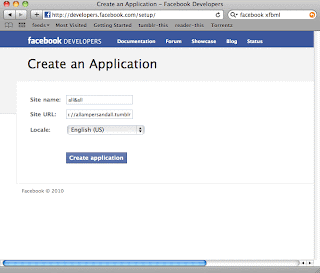
Step One: Sign Up for Facebook Developer Access

I'm hoping you already have a facebook login. Using said login, head over here and fill out the form supplying your page name and url.

After that is done it will give you the application ID-- you're going to need this for the next step.

Editing Your Blogger Template

Ok so sign in to your blogger admin and navigate to layout > edit html. Make sure you check the "Expand Widget Templates" checkbox.

Now comes the tricky/nerdy inserting code part. Inside of that box where the code is, you'll see at the top of it a tag that starts with <html. We need to add xmlns:fb='http://www.facebook.com/2008/fbml' inside of that tag (which means we need to put it inbetween the < and > symbols for those of you not too html savvy). . So your final <html> tag should look similar to this:

<html expr:dir='data:blog.languageDirection' xmlns='http://www.w3.org/1999/xhtml' xmlns:b='http://www.google.com/2005/gml/b' xmlns:data='http://www.google.com/2005/gml/data' xmlns:expr='http://www.google.com/2005/gml/expr' xmlns:fb='http://www.facebook.com/2008/fbml'>

The important part is that you got that xmlns:fb facebook part. The next step is to scroll down and look for the <body> tag. In the picture below you'll see the body tag, and then the code you need to insert below it.

You're going to substitute my app id for your app id--which should be a string of numbers--no symbols, letters or anything else. Your final code should look like so:

<div id='fb-root'/>
<script>
  window.fbAsyncInit = function() {
    FB.init({appId: YOUR-APP-ID, status: true, cookie: true,
             xfbml: true});
  };
  (function() {
    var e = document.createElement('script'); e.async = true;
    e.src = document.location.protocol +
      '//connect.facebook.net/en_US/all.js';
    document.getElementById('fb-root').appendChild(e);
  }());
</script>

Remember, substitute YOUR-APP-ID for your appication ID you got when you signed up above. We're almost there, one more change! Now we need to find
<div class="post-footer">. We're going to add the tag that begins with fb:like in there.

So your final code there should be similar to:

<div class="post-footer">
<fb:like action='like' colorscheme='light' expr:href='data:post.url' layout='standard' show-faces='false' width='450'/>
</div>

That's it! All done! Be sure to like this post below ;-)

Monday, May 3, 2010

Making Cross Domain jQuery AJAX Calls

Today's web browsers do not allow web pages to make cross-domain ajax calls. By this i mean that if you are at www.ajax.com and try to make an Ajax call ( an HTTP request using the XmlHttpRequest object) to www.other-domain.com the browser would not allow this to happen. Why? For security purposes that i cannot currently name.

However, at some point you get to a project where you're interfacing this third-party site that needs to talk to your main site, or some other similar situation where the only way you're going to get the data you need from point a to point b is with some javascript magic. Here is how to accomplish it:

How to get/post data using jQuery/javascript (JSONP)

The short answer: its not ajax at all, its JSONP. Yes, JSONP is not Ajax. I just learned this today. Like i said earlier, browsers do not allow XHR/Ajax cross-browser requests. JSONP avoids this by making a request for a script file-- no Ajax at all. Let me explain:

  1. Instead of accessing the XHR object, the browser first creates a new script tag to inject into the HTML DOM
  2. The script tag's URL is set to the URL you're looking to get/post(using HTTP GET) data to
  3. The script tag is injected into the page, causing...
  4. The request is sent to the server, even if its cross-domain
  5. The server returns the data in the form of a javascript function call
  6. The browser receives the data and executes the function call

jQuery code

//use a get to post a querystring value via HTTP GET to an asp.net webhandler
$.getJSON("http://www.example.com/get-post.ashx?var1=var1value&callback=?",function(data){
     //really no need to do anything here, we're just posting data
     //but this will output success
     alert(data.return);
});

asp.net generic handler/webhandler code

using System;
using System.Collections.Generic;
using System.Linq;
using System.Web;
using System.Web.Services;

namespace jsonp_test
{
    /// 
    /// Summary description for $codebehindclassname$
    /// 
    [WebService(Namespace = "http://tempuri.org/")]
    [WebServiceBinding(ConformsTo = WsiProfiles.BasicProfile1_1)]
    public class get_post : IHttpHandler
    {

        public void ProcessRequest(HttpContext context)
        {
            string callback = "";
            try
            {
                if (!string.IsNullOrEmpty(context.Request["callback"]))
                {
                    if (!string.IsNullOrEmpty(context.Request["var1"]))
                        SaveData(context.Request["var1"]);
                    callback = context.Request["callback"];

                    context.Response.Write(callback + "({ \"return\": \"Success\" })");
                }
            }
            catch (Exception exc)
            {
                //hopefully this error doesnt contain any quotes... you know?
                context.Response.Write(callback + "({ \"return\": \"" + exc.Message + "\" })");
            }
        }

        private void SaveData(string value)
        {
            //do something with the var1 posted to us
        }

        public bool IsReusable
        {
            get
            {
                return false;
            }
        }
    }
}

So what we effectively have here is the setup for asp.net cross domain ajax calls using jQuery

How to do cross-domain calls to others' servers: YQL

What if you need to do a get but don't have the ability to make the page its posting to return a JSONP response? Using YQL is a great way to achieve this.

YQL is a way to query the internet like it is a database. For example, one could easily run

select * from html where url="http://www.microsoft.com"

and recieve a JSONP return containing all of the site's HTML. You could also, do the following

select * from html where url="http://www.mircorosft.com?var1=var1value"

and HTTP GET values to the server. YQL does not allow this to happen on any area of any site that is blocked by the robots.txt file. Here's full example code:

//feel free to add querystring vars to this
var myurl="http://www.example.com/get-post.ashx?var1=var1value&callback=?";
//make the call to YQL 
$.getJSON("http://query.yahooapis.com/v1/public/yql?"+
                "q=select%20*%20from%20html%20where%20url%3D%22"+
                encodeURIComponent(myurl)+
                "%22&format=xml'&callback=?",
        function(data){
          if(data.results[0]){
            //this data.results[0] is the return object you work with, 
            //if you actually want to do something with the returned json
            alert(data.results[0]);
          } else {
            var errormsg = '

Error: could not load the page.

'; //output to firebug's console //use alert() for other browsers/setups conole.log(errormsg); } } );

Wednesday, March 31, 2010

Random Order LINQ Query

I get a lot of requests for random ordering at my job... this helps a lot.

(from s in myset orderby Guid.NewGuid() select s).Take(5)

Updated 10/4/2011

Wednesday, February 10, 2010

C# Design Patterns: Factory

What is the factory design pattern? Well to begin with it is something that is referenced frequently in software architecture. Functionally, a factory builds an object. More specifically, factories render instances of an abstract class type.

C# Example

How often have you got caught up in creating objects based upon business logic? Something like this:

 public interface ICar
{
 decimal Price {get;set;}
 int HorsePower{get;set;}
}
//found somewhere randomly in your code...
 ICar result;
 //this code is heavily biased
 if(user.IsRich)
  return new AstonMartin();
 else if(user.IsSteelWorker)
  return new Ford();
 else if(user.IsPractical)
  return new Honda();
 return MomsCar();

I've found code like this in projects many times and have done it myself. What's really wrong with this?

  1. If you need this code again, and copy/paste, you'll be violating DRY (do not repeat yourself)
  2. Not reusable
  3. Not centrally based, so a change in one place will need copied to another
  4. Whatever class this code is in is at this point violating the Single Responsibility Principle

The Factory Design Pattern Fix

Take a look over why this is architectually better:

public enum CarTypes { NotSet, Honda, AstonMartin, Ford };
public sealed class CarFactory
{
    public ICar Create(CarTypes cType)
    {
        if (cType == CarTypes.Honda)
            return new Honda();
        else if (cType == CarTypes.AstonMartin)
            return new AstonMartin();
        else if (cType == CarTypes.Ford)
            return new Ford();
        throw new ArgumentOutOfRangeException("cType");
    }
}

What have we changed in this example?

  1. All of our code is in one area--easy to update and reuse
  2. The factory is sealed, so we need not worry about any other classes changing the factory behavior

Simple stuff!

Monday, February 1, 2010

Dependency Injection in .NET

I'm really on an architecture kick at this point. Honestly, it's probably about time. I find few senior-style job postings that do not ask for some knowledge of Spring.NET or Castle Windsor. Now that i've done a little reading up on the subject, I see that this is for good reason.


Introduction: What is Dependency Injection?


This stuff is tricky--I'm not going to lie. First of all, I would recommend reading up on the basics. Until you start to really see the power behind defining interfaces and working with abstractions dependency injection will be unnecessary for you.


Dependency Injection strives to decouple classes from dependencies. For instance:


public interface IComplaintHearer
{
void RegisterComplaint(string message);
}
public class Manager : IComplaintHearer
{
public Manager() { }
public void RegisterComplaint(string message)
{
//do something with message
}
}
public class Employee
{
//completely dependent upon this exact class
private Manager _itsManager;
public Employee() { }
public void Complain(string complaint)
{
_itsManager.RegisterComplaint(complaint);
}
}

What's the issue? What if we want the employee to report to someone other than its immediate boss? Or, what if we want the employee to complain to a co-worker? We would have to completely change the class. Right now this code completely violates the open closed principle(among others) we discussed when reviewing the S.O.L.I.D. principles. So lets use the dependency inversion principle and make this class dependent upon an abstraction:


public interface IComplaintHearer
{
void RegisterComplaint(string message);
}
public class Manager : IComplaintHearer
{
public Manager() { }
public void RegisterComplaint(string message)
{
//do something with message
}
}
public class Employee:IComplaintHearer
{
//completely dependent upon this exact class
private IComplaintHearer _complaintHearer;
public Employee(IComplaintHearer hearer)
{
_complaintHearer=hearer;
}
public void RegisterComplaint(string message)
{
//do something with the message
}
public void Complain(string complaint)
{
_complaintHearer.RegisterComplaint(complaint);
}
}

And we would need to run this code like so:


//we could pass a manager, or another employee if we wanted to
Employee myEmp = new Employee(new Manager());

Injecting the Class, Instead of Providing It


Imagine a scenario where we had tons of classes that implemented the IComplaintHearer interface. We'd have to recompile the code everytime we want to change who the employee complains to. This is where a dependency injection steps in and allows you to:


  1. Specify a class's dependency at run-time
  2. Dynamically use classes in another assembly
  3. Make changes without recompilation

Let's take a look at an example:


public interface IComplaintHearer
{
void RegisterComplaint(string message);
}
public class Manager : IComplaintHearer
{
public Manager() { }
public void RegisterComplaint(string message)
{
//do something with message
}
}
public class Employee:IComplaintHearer
{
//completely dependent upon this exact class
private IComplaintHearer _complaintHearer;

//use the IComplaintHearer subclass that the Dependency Injection Framework (StructureMap in this case) tells us to
// this depends upon the xml that defines what to use (below)
public Employee(): this ( ObjectFactory.GetInstance()){}
public Employee(IComplaintHearer hearer)
{
_complaintHearer=hearer;
}
public void RegisterComplaint(string message)
{
//do something with the message
}
public void Complain(string complaint)
{
_complaintHearer.RegisterComplaint(complaint);
}
}


What just happened? By using the StructureMap Framework for .NET, we just specified the IComplaintHearer that our employee class will default to--the manager. In the XML above, we mapped the expected type/assembly to the default type/assembly. Further, we could set up defaults for all of our classes that we could change later without ever having to change any code. In some ways, I feel like this is moving a problem from one environment to another, but in other ways i think it is a great architectural tool.


What do you think?


Friday, January 29, 2010

The S.O.L.I.D. Object Oriented Programming(OOP) Principles

Introduction


What does it take to be an Object Oriented Programmer? There was a time where I believed all that meant was that you worked with a language such as C#, C++, or Java. However, the more I get acquainted with newer technologies, the more I realize that there is a set of fundamentals core to the title. And really, these fundamentals are about architecting the best, most update-able, scalable systems. Just yesterday while diving into DataObjects.NET I was greeted by Domain Driven Design(DDD)-- a popular architectural abstraction. It motivated me to think about the basics, which is the purpose of this article.


The S.O.L.I.D. Principles of Class Design


The S.O.L.I.D. principles seem to be the least common denominator of creating great classes; even before Design Patterns. I recommend taking some time to really think about each of them and how you can apply them. Lets dive in, one by one.


The Single Responsibility Principle


There should never be more than one reason for a class to change. Basically, this means that your classes should exist for one purpose only. For example, lets say you are creating a class to represent a SalesOrder. You would not want that class to save to the database, as well as export an XML-based receipt. Why? Well if later on down the road you want to change database type(or if you want to change your XML schema), you're allowing one responsibility's changes to possibly alter another. Responsibility is the heart of this principle, so to rephrase there should never be more than one responsibility per class.


The Open Closed Principle


Software entities(classes,modules,functions,etc.) should be open for extension, but closed for modification. At first this seems to be contradictory: how can you make an object behave differently without modifying it? The answer: by using abstractions, or by placing behavior(responsibility) in derivative classes. In other words, by creating base classes with override-able functions we are able to create new classes that do the same thing differently without changing the base functionality. Further, if properties of the abstracted class need compared or organized together, another abstraction should handle this. This is the basis of the "keep all object variables private" argument.


The Liskov Substitution Principle


Functions that use pointers or references to base classes must be able to use objects of derived classes without knowing it.In other words, if you are calling a method defined at a base class upon an abstracted class, the function must be implemented properly on the subtype class. Or, "when using an object through its base class interface,[ the]derived object must not expect such users to obey preconditions that are stronger than those required by the base class." The ever-popular illustration of this is the square-rectangle example. Turns out a square is not a rectangle, at least behavior-wise.


The Dependency Inversion Principle


Depend on abstractions, not on concretions or High level modules should not depend upon low level modules. Both should depend upon abstractions. Abstractions should not depend upon details. Details should depend upon abstractions. (I like the first explanation the best.) This is very closely related to the open closed principle we discussed earlier. By passing dependencies (such as connectors to devices, storage) to classes as abstractions, you remove the need to program dependency specific. Here's an example: a Employee class that needs to be able to be persisted to xml and a database. If we placed ToXML() and ToDB() functions in the class, we'd be violating the single responsibility principle. If we created a function that took a value that represented whether to print to XML or to DB, we'd be hard-coding a set of devices and thus be violating the open closed principle. The best way to do this would be to: 1) Create an abstract class (named DataWriter, perhaps) that can be inherited from for XML (XMLDataWriter) or DB (DbDataWriter) Saving, and then 2) Create a class (named EmployeeWriter) that would expose an Output(DataWriter saveMethod) that accepts a dependency as an argument. See how the Output method is dependent upon the abstractions just as the output types are? The dependencies have been inverted. Now we can create new types of ways for Employee data to be written, perhaps via HTTP/HTTPS by creating abstractions, and without modifying any of our previous code! No rigidity--the desired outcome.


The Interface Segregation Principle


Clients should not be forced to depend upon interfaces that they do not use. My favorite version of this is written as "when a client depends upon a class that contains inter- faces that the client does not use, but that other clients do use, then that client will be affected by the changes that those other clients force upon the class." Kinda sounds like the inheritance specific single responsibility principle.


Sources