Sunday, October 2, 2011

The Repository Pattern

I'm not sure if Martin Fowler conceptualized the repository pattern, but his book Patterns of Enterprise Application Architecture (PoEAA) is where I first came across the definition:

"Mediates between the domain and data mapping layers using a collection-like interface for accessing domain objects."

He has very carefully selected his words. I have my own definition. Consider it the layman's version:

"Separates data from its source." 

Let's dig into an example.

The Repository Pattern in .NET

Every .NET programmer has written some sort of code that accesses a database or web service and returns something. Traditionally, the ever-present n-tier/three-tier philosophy dictates that the code for that should be in its own package/layer, the data access layer. What that philosophy does not dictate is the method signature and the return type; they're extremely important. Let's look at your traditional DAL:

What will the dev on this project do if the People DB gets outsourced and is now accessed via webservice? Convert the web service return into datasets, or change all the business layer classes to work with whatever the new return is? Or, what if they change to a db that doesnt easily convert into datasets? Not a great position to be in... Why not change it to something more generic that will never change?...

Here's a look at the repository pattern implementation:

Notice how this implementation could survive through any sort of data source change because it is using "a collection-like interface"? Much more maintainable.

The Repository Pattern in JavaScript

JavaScript's implementation would need to take into account the fact that AJAX requests (or all node.js functions) are meant to happen asynchronously. In order to allow for this, all we really need to do is implement the callback pattern, which really just boils down to passing an extra function.

That's it!

Wednesday, December 1, 2010

.NET-- Explicit Cast or Use "as"?

In .NET there are 2 different ways to cast an object from one to another-- by explicitly casting like (OtherObject)startObject (I call this the explicit cast) or by using the as keyword like startObject as OtherObject. What are the advantages/drawbacks of using one or the other?


Why You Should Use "as"

Do you know what goes on behind an explicit cast? If the type to be converted does not match the wanted type at runtime, it tries to use any user defined conversions to create a completely new type. Also, if the explicit cast doesn't work it throws an error.

The "as" keyword doesn't have these drawbacks. If the cast fails, the newly created object is null; there's no error. And again, no conversion/new object creation occurs. Win-win.

"As" does have a downside though--it cannot be used on value types. Doesn't really come as a surprise though, remembering that it will not do new object creation...

Thursday, May 20, 2010

How to Add a Facebook Like Button to Your Blogger Posts

A friend of mine that owns a Pittsburgh-based custom t-shirts and screen printing business asked me the other day if I could research adding Facebook like buttons to his posts. Here is the result of said research:

Step One: Sign Up for Facebook Developer Access

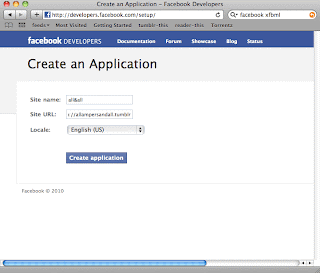
I'm hoping you already have a facebook login. Using said login, head over here and fill out the form supplying your page name and url.

After that is done it will give you the application ID-- you're going to need this for the next step.

Editing Your Blogger Template

Ok so sign in to your blogger admin and navigate to layout > edit html. Make sure you check the "Expand Widget Templates" checkbox.

Now comes the tricky/nerdy inserting code part. Inside of that box where the code is, you'll see at the top of it a tag that starts with <html. We need to add xmlns:fb='http://www.facebook.com/2008/fbml' inside of that tag (which means we need to put it inbetween the < and > symbols for those of you not too html savvy). . So your final <html> tag should look similar to this:

<html expr:dir='data:blog.languageDirection' xmlns='http://www.w3.org/1999/xhtml' xmlns:b='http://www.google.com/2005/gml/b' xmlns:data='http://www.google.com/2005/gml/data' xmlns:expr='http://www.google.com/2005/gml/expr' xmlns:fb='http://www.facebook.com/2008/fbml'>

The important part is that you got that xmlns:fb facebook part. The next step is to scroll down and look for the <body> tag. In the picture below you'll see the body tag, and then the code you need to insert below it.

You're going to substitute my app id for your app id--which should be a string of numbers--no symbols, letters or anything else. Your final code should look like so:

<div id='fb-root'/>
<script>
  window.fbAsyncInit = function() {
    FB.init({appId: YOUR-APP-ID, status: true, cookie: true,
             xfbml: true});
  };
  (function() {
    var e = document.createElement('script'); e.async = true;
    e.src = document.location.protocol +
      '//connect.facebook.net/en_US/all.js';
    document.getElementById('fb-root').appendChild(e);
  }());
</script>

Remember, substitute YOUR-APP-ID for your appication ID you got when you signed up above. We're almost there, one more change! Now we need to find
<div class="post-footer">. We're going to add the tag that begins with fb:like in there.

So your final code there should be similar to:

<div class="post-footer">
<fb:like action='like' colorscheme='light' expr:href='data:post.url' layout='standard' show-faces='false' width='450'/>
</div>

That's it! All done! Be sure to like this post below ;-)

Monday, May 3, 2010

Making Cross Domain jQuery AJAX Calls

Today's web browsers do not allow web pages to make cross-domain ajax calls. By this i mean that if you are at www.ajax.com and try to make an Ajax call ( an HTTP request using the XmlHttpRequest object) to www.other-domain.com the browser would not allow this to happen. Why? For security purposes that i cannot currently name.

However, at some point you get to a project where you're interfacing this third-party site that needs to talk to your main site, or some other similar situation where the only way you're going to get the data you need from point a to point b is with some javascript magic. Here is how to accomplish it:

How to get/post data using jQuery/javascript (JSONP)

The short answer: its not ajax at all, its JSONP. Yes, JSONP is not Ajax. I just learned this today. Like i said earlier, browsers do not allow XHR/Ajax cross-browser requests. JSONP avoids this by making a request for a script file-- no Ajax at all. Let me explain:

  1. Instead of accessing the XHR object, the browser first creates a new script tag to inject into the HTML DOM
  2. The script tag's URL is set to the URL you're looking to get/post(using HTTP GET) data to
  3. The script tag is injected into the page, causing...
  4. The request is sent to the server, even if its cross-domain
  5. The server returns the data in the form of a javascript function call
  6. The browser receives the data and executes the function call

jQuery code

//use a get to post a querystring value via HTTP GET to an asp.net webhandler
$.getJSON("http://www.example.com/get-post.ashx?var1=var1value&callback=?",function(data){
     //really no need to do anything here, we're just posting data
     //but this will output success
     alert(data.return);
});

asp.net generic handler/webhandler code

using System;
using System.Collections.Generic;
using System.Linq;
using System.Web;
using System.Web.Services;

namespace jsonp_test
{
    /// 
    /// Summary description for $codebehindclassname$
    /// 
    [WebService(Namespace = "http://tempuri.org/")]
    [WebServiceBinding(ConformsTo = WsiProfiles.BasicProfile1_1)]
    public class get_post : IHttpHandler
    {

        public void ProcessRequest(HttpContext context)
        {
            string callback = "";
            try
            {
                if (!string.IsNullOrEmpty(context.Request["callback"]))
                {
                    if (!string.IsNullOrEmpty(context.Request["var1"]))
                        SaveData(context.Request["var1"]);
                    callback = context.Request["callback"];

                    context.Response.Write(callback + "({ \"return\": \"Success\" })");
                }
            }
            catch (Exception exc)
            {
                //hopefully this error doesnt contain any quotes... you know?
                context.Response.Write(callback + "({ \"return\": \"" + exc.Message + "\" })");
            }
        }

        private void SaveData(string value)
        {
            //do something with the var1 posted to us
        }

        public bool IsReusable
        {
            get
            {
                return false;
            }
        }
    }
}

So what we effectively have here is the setup for asp.net cross domain ajax calls using jQuery

How to do cross-domain calls to others' servers: YQL

What if you need to do a get but don't have the ability to make the page its posting to return a JSONP response? Using YQL is a great way to achieve this.

YQL is a way to query the internet like it is a database. For example, one could easily run

select * from html where url="http://www.microsoft.com"

and recieve a JSONP return containing all of the site's HTML. You could also, do the following

select * from html where url="http://www.mircorosft.com?var1=var1value"

and HTTP GET values to the server. YQL does not allow this to happen on any area of any site that is blocked by the robots.txt file. Here's full example code:

//feel free to add querystring vars to this
var myurl="http://www.example.com/get-post.ashx?var1=var1value&callback=?";
//make the call to YQL 
$.getJSON("http://query.yahooapis.com/v1/public/yql?"+
                "q=select%20*%20from%20html%20where%20url%3D%22"+
                encodeURIComponent(myurl)+
                "%22&format=xml'&callback=?",
        function(data){
          if(data.results[0]){
            //this data.results[0] is the return object you work with, 
            //if you actually want to do something with the returned json
            alert(data.results[0]);
          } else {
            var errormsg = '

Error: could not load the page.

'; //output to firebug's console //use alert() for other browsers/setups conole.log(errormsg); } } );

Wednesday, March 31, 2010

Random Order LINQ Query

I get a lot of requests for random ordering at my job... this helps a lot.

(from s in myset orderby Guid.NewGuid() select s).Take(5)

Updated 10/4/2011

Wednesday, February 10, 2010

C# Design Patterns: Factory

What is the factory design pattern? Well to begin with it is something that is referenced frequently in software architecture. Functionally, a factory builds an object. More specifically, factories render instances of an abstract class type.

C# Example

How often have you got caught up in creating objects based upon business logic? Something like this:

 public interface ICar
{
 decimal Price {get;set;}
 int HorsePower{get;set;}
}
//found somewhere randomly in your code...
 ICar result;
 //this code is heavily biased
 if(user.IsRich)
  return new AstonMartin();
 else if(user.IsSteelWorker)
  return new Ford();
 else if(user.IsPractical)
  return new Honda();
 return MomsCar();

I've found code like this in projects many times and have done it myself. What's really wrong with this?

  1. If you need this code again, and copy/paste, you'll be violating DRY (do not repeat yourself)
  2. Not reusable
  3. Not centrally based, so a change in one place will need copied to another
  4. Whatever class this code is in is at this point violating the Single Responsibility Principle

The Factory Design Pattern Fix

Take a look over why this is architectually better:

public enum CarTypes { NotSet, Honda, AstonMartin, Ford };
public sealed class CarFactory
{
    public ICar Create(CarTypes cType)
    {
        if (cType == CarTypes.Honda)
            return new Honda();
        else if (cType == CarTypes.AstonMartin)
            return new AstonMartin();
        else if (cType == CarTypes.Ford)
            return new Ford();
        throw new ArgumentOutOfRangeException("cType");
    }
}

What have we changed in this example?

  1. All of our code is in one area--easy to update and reuse
  2. The factory is sealed, so we need not worry about any other classes changing the factory behavior

Simple stuff!

Monday, February 1, 2010

Dependency Injection in .NET

I'm really on an architecture kick at this point. Honestly, it's probably about time. I find few senior-style job postings that do not ask for some knowledge of Spring.NET or Castle Windsor. Now that i've done a little reading up on the subject, I see that this is for good reason.


Introduction: What is Dependency Injection?


This stuff is tricky--I'm not going to lie. First of all, I would recommend reading up on the basics. Until you start to really see the power behind defining interfaces and working with abstractions dependency injection will be unnecessary for you.


Dependency Injection strives to decouple classes from dependencies. For instance:


public interface IComplaintHearer
{
void RegisterComplaint(string message);
}
public class Manager : IComplaintHearer
{
public Manager() { }
public void RegisterComplaint(string message)
{
//do something with message
}
}
public class Employee
{
//completely dependent upon this exact class
private Manager _itsManager;
public Employee() { }
public void Complain(string complaint)
{
_itsManager.RegisterComplaint(complaint);
}
}

What's the issue? What if we want the employee to report to someone other than its immediate boss? Or, what if we want the employee to complain to a co-worker? We would have to completely change the class. Right now this code completely violates the open closed principle(among others) we discussed when reviewing the S.O.L.I.D. principles. So lets use the dependency inversion principle and make this class dependent upon an abstraction:


public interface IComplaintHearer
{
void RegisterComplaint(string message);
}
public class Manager : IComplaintHearer
{
public Manager() { }
public void RegisterComplaint(string message)
{
//do something with message
}
}
public class Employee:IComplaintHearer
{
//completely dependent upon this exact class
private IComplaintHearer _complaintHearer;
public Employee(IComplaintHearer hearer)
{
_complaintHearer=hearer;
}
public void RegisterComplaint(string message)
{
//do something with the message
}
public void Complain(string complaint)
{
_complaintHearer.RegisterComplaint(complaint);
}
}

And we would need to run this code like so:


//we could pass a manager, or another employee if we wanted to
Employee myEmp = new Employee(new Manager());

Injecting the Class, Instead of Providing It


Imagine a scenario where we had tons of classes that implemented the IComplaintHearer interface. We'd have to recompile the code everytime we want to change who the employee complains to. This is where a dependency injection steps in and allows you to:


  1. Specify a class's dependency at run-time
  2. Dynamically use classes in another assembly
  3. Make changes without recompilation

Let's take a look at an example:


public interface IComplaintHearer
{
void RegisterComplaint(string message);
}
public class Manager : IComplaintHearer
{
public Manager() { }
public void RegisterComplaint(string message)
{
//do something with message
}
}
public class Employee:IComplaintHearer
{
//completely dependent upon this exact class
private IComplaintHearer _complaintHearer;

//use the IComplaintHearer subclass that the Dependency Injection Framework (StructureMap in this case) tells us to
// this depends upon the xml that defines what to use (below)
public Employee(): this ( ObjectFactory.GetInstance()){}
public Employee(IComplaintHearer hearer)
{
_complaintHearer=hearer;
}
public void RegisterComplaint(string message)
{
//do something with the message
}
public void Complain(string complaint)
{
_complaintHearer.RegisterComplaint(complaint);
}
}


What just happened? By using the StructureMap Framework for .NET, we just specified the IComplaintHearer that our employee class will default to--the manager. In the XML above, we mapped the expected type/assembly to the default type/assembly. Further, we could set up defaults for all of our classes that we could change later without ever having to change any code. In some ways, I feel like this is moving a problem from one environment to another, but in other ways i think it is a great architectural tool.


What do you think?